

Dynamic knee valgus: hip adduction, knee caving in and pronation
We measure hip, knee and ankle alignment in motion and correct the pattern with retraining, strength and, when the foot is the driver, custom insoles.
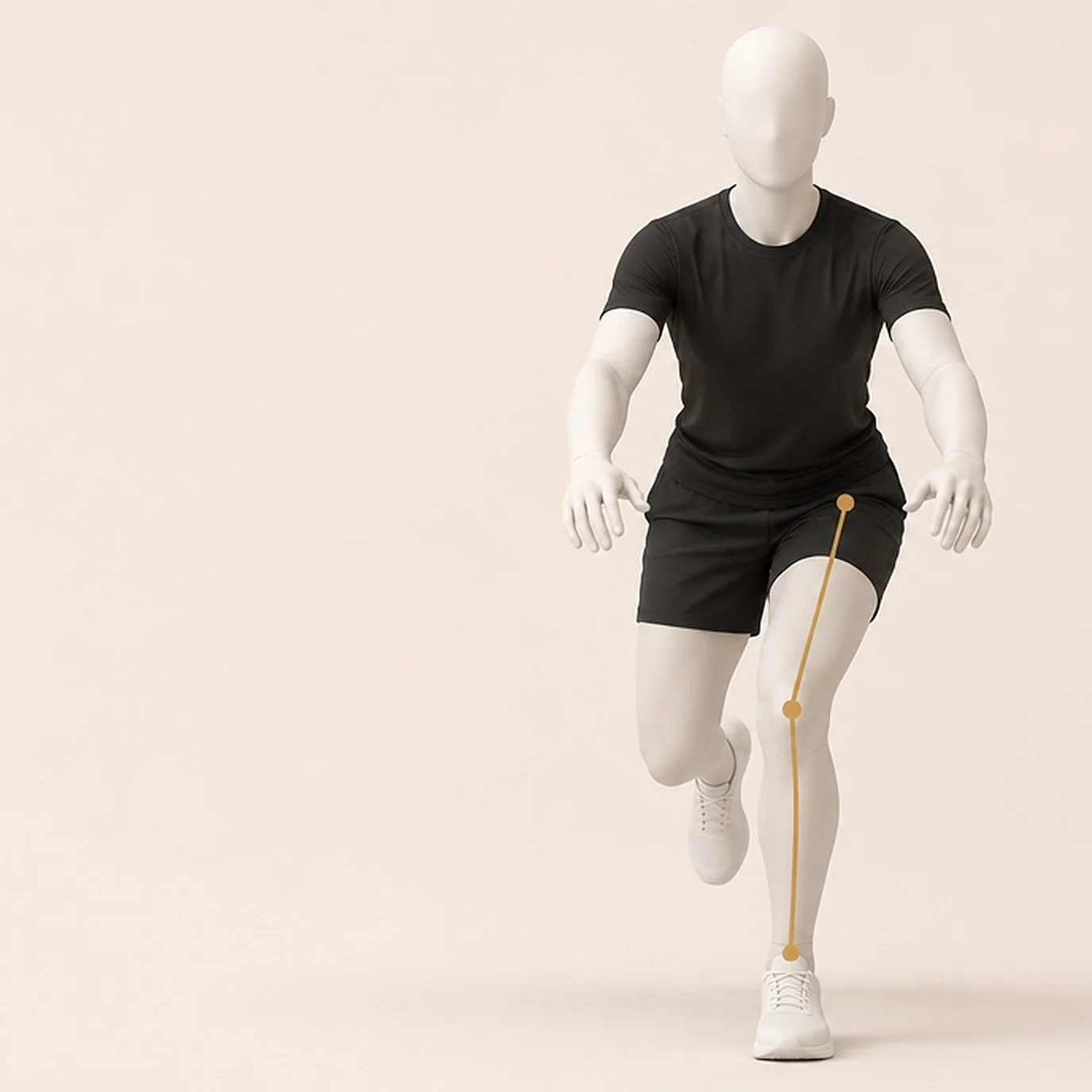
Does your knee cave in when you squat, go downstairs or run?
Dynamic valgus is a chain movement pattern: the thigh moves towards the midline and turns in, the knee drifts inwards and the ankle collapses into pronation. You cannot see it standing still, only in motion, and it is one of the patterns most linked to knee pain and overuse injuries.
Last reviewed: November 2026 · Dr. Miguel Reis e Silva, Sports Medicine (OM 52856)
What is dynamic knee valgus?
It is the inward movement of the knee during single-leg loaded movements: squatting, stepping down, landing from a jump, running or changing direction. It is the sum of three components:
Hip: adduction and internal rotation of the thigh.
Knee: inward shift relative to the foot.
Ankle and foot: dynamic pronation, with the arch dropping.
Associated problems
Pain at the front of the knee (patellofemoral pain).
Iliotibial band syndrome and tendinopathies.
Higher risk of anterior cruciate ligament injury in sports with jumping and cutting.
Foot and shin pain in runners.
Why it happens
Hip: weak or underactive gluteus medius and external rotators.
Ankle: limited dorsiflexion, which forces the foot to pronate so the knee can move forward.
Foot: poor arch control or excessive pronation.
Motor control: the pattern has been learned and repeats automatically, especially when tired.
Knowing whether the driver is at the hip or the ankle changes the treatment. That is what biomechanical analysis shows.
How we measure it
With biomechanical analysis using video and sensors:
Single-leg squat and lateral step-down — frontal-plane knee projection angle, hip adduction and rotation and pelvic drop.
Drop jump and hop and hold — alignment on landing and stability after landing.
Side-view squat — contribution of ankle dorsiflexion, knee, hip and trunk.
Treadmill walking and running — dynamic pronation and alignment at every stride.
Foot — 3D scanning and loading assessment.
We compare right with left and with reference values.
KINESTA
These tests are part of KINESTA, the biomechanical analysis app created by the founders of Myalgia Clinic. At Myalgia we use it to measure dynamic valgus objectively, compare reassessments and give you a clear report.
How we correct it
Hip strength — gluteus medius, gluteus maximus and external rotators, first in isolation and then in single-leg movements.
Ankle mobility — when dorsiflexion is limited.
Foot control — exercises for the arch and the intrinsic foot muscles.
Pattern retraining with biofeedback — squatting, stepping down, landing and running with the knee aligned, watching the movement in real time.
Running technique — cadence, stride and foot strike, if you run.
Custom insoles — when foot pronation is the driver, designed from the biomechanical assessment and 3D printed.
If there is knee pain, swelling or locking, we start with a medical consultation with ultrasound.
Postural reeducation at Myalgia
Dynamic valgus is one of the four patterns we treat in our global postural reeducation (GPR / RPG) programme, with one-to-one 60-minute GPR sessions and doctors on site. See also knee pain and osteoarthritis.
Myalgia Clinic Lisbon — Rua Adelaide Cabete 7A, Quinta da Luz, Carnide. See the clinic
Myalgia Clinic Almada — Rua Luís de Queiroz 5A, Almada town centre. See the clinic
Myalgia Center Miraflores — physiotherapy centre at Avenida das Túlipas 18A, Algés (Oeiras). See the centre
Other postural patterns
Frequently asked questions
What is dynamic knee valgus?
It is the inward movement of the knee during single-leg loaded movements, caused by hip adduction and internal rotation and foot pronation.
Is dynamic valgus the same as knock knees?
No. Knock knees (genu valgum) are a feature of leg shape, visible when standing. Dynamic valgus is a movement pattern that can occur with straight legs and can be trained.
Which exercises fix a knee that caves in?
Strengthening the gluteus medius and hip external rotators, ankle mobility, foot control and training the squat and jump landing with the knee aligned. The order depends on where the driver is.
Do insoles fix dynamic valgus?
They help when foot pronation is the source of the pattern. When the driver is at the hip, the main treatment is strength and control. Biomechanical analysis tells us which is your case.
I run and have knee pain. Could it be this?
It could. Dynamic valgus is one of the most common causes of front-of-knee pain in runners. We assess your running on the treadmill.
How much does it cost?
Prices are on the booking page.