

Forward head posture and rounded shoulders: assessment and correction
We measure how far your head and shoulders sit forward, treat with GPR sessions and strength, and use the Shoulder Pacemaker to retrain the shoulder blade.
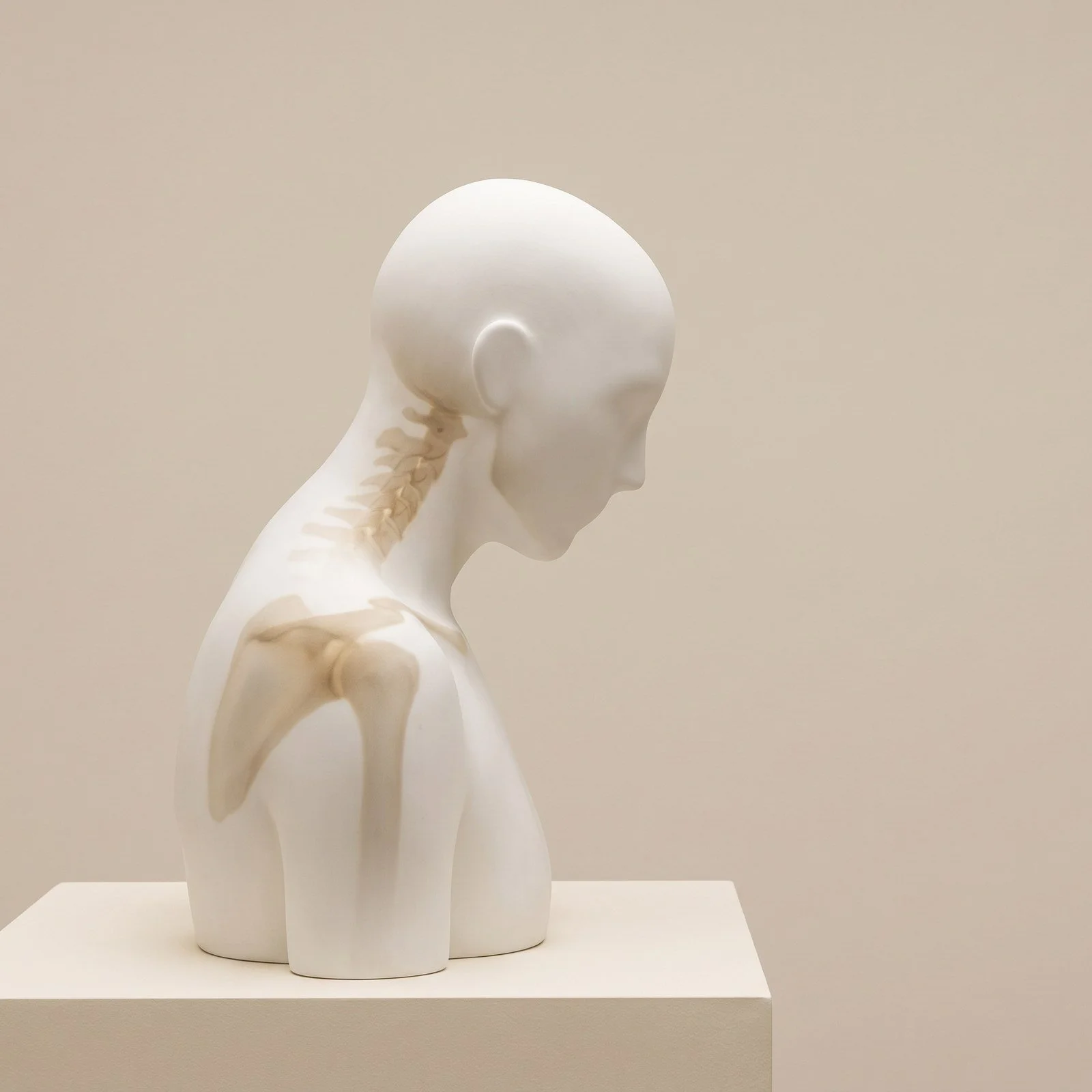
Tight neck at the end of the day, rounded shoulders, pain lifting your arm?
Forward head posture with rounded shoulders is the most common postural pattern in people who spend long hours at a computer or on their phone. It is not just about appearance: every centimetre the head moves forward increases the load on the neck muscles, and rounded shoulders change the way the shoulder blade moves.
Last reviewed: November 2026 · Dr. Miguel Reis e Silva, Sports Medicine (OM 52856)
What are forward head posture and rounded shoulders?
Seen from the side, the ear should sit roughly in line with the shoulder. In forward head posture, the head pokes forward and the chin tends to lift. With rounded shoulders, the shoulder blade moves away from the spine and tips forward, and the shoulder rotates inwards.
The two patterns usually appear together, often with thoracic hyperkyphosis underneath.
Common signs
Tension or pain in the neck and at the base of the skull, especially late in the day.
Tension-type headaches.
Pain at the front or side of the shoulder when lifting the arm.
Tingling in the arms in certain positions (which needs medical assessment).
Feeling tired when trying to sit up straight.
Why it happens
Sustained positions: hours at the computer, on the phone or driving, with the screen below eye level.
Muscle imbalance: tight chest and front-of-neck muscles; underactive deep neck flexors, middle and lower trapezius and shoulder external rotators.
Stiff upper back: if the thoracic spine does not extend, the head and shoulders compensate forward.
Unbalanced training: lots of chest work and little back work.
Over time this pattern is linked to neck pain, subacromial impingement and rotator cuff tendinopathy. Read more about shoulder pain and neck pain.
How we measure it
With biomechanical analysis, using calibrated photos and video:
Craniovertebral angle — the angle between the horizontal through C7 and the line to the ear (tragus). The smaller it is, the further forward the head; values below about 50° are usually considered forward head posture.
Shoulder position relative to the plumb line and the ratio between front and back shoulder distance.
Upper-back mobility in extension and rotation.
Shoulder-blade movement when raising the arm (scapular dyskinesis) and external rotator strength.
We repeat the same measurements at each reassessment, so progress is tracked in numbers, not impressions.
How we correct it
GPR sessions (global postural reeducation) — active postures that lengthen the front chain (pectoralis minor, front-of-neck muscles) while activating the back muscles, with breathing control.
Upper-back mobility — without thoracic extension, the head and shoulders cannot stay back.
Strength and control — deep neck flexors, middle and lower trapezius, serratus anterior and external rotators, with progressive load.
Ergonomics and habits — screen at eye level, breaks every 30 to 45 minutes, changing positions.
Shoulder Pacemaker
When the shoulder blade does not learn the right pattern through exercise alone, we use the Shoulder Pacemaker. It is a neuromuscular stimulator worn during the session: a motion sensor detects arm elevation and, at that moment, activates the muscles that draw the shoulder blade back and rotate the shoulder outwards. The brain learns to feel and repeat the correct pattern.
It was developed to retrain shoulder muscle-activation patterns. In a multicentre randomised trial in functional shoulder instability, physiotherapy with the Shoulder Pacemaker achieved better results than physiotherapy alone.
When shoulder pain does not settle, we assess it in a medical consultation with same-day ultrasound.
Postural reeducation at Myalgia
This is one of the four patterns we treat in our global postural reeducation (GPR / RPG) programme. GPR sessions are one-to-one, 60 minutes, with physiotherapists, and doctors are on site when needed.
Myalgia Clinic Lisbon — Rua Adelaide Cabete 7A, Quinta da Luz, Carnide. See the clinic
Myalgia Clinic Almada — Rua Luís de Queiroz 5A, Almada town centre. See the clinic
Myalgia Center Miraflores — physiotherapy centre at Avenida das Túlipas 18A, Algés (Oeiras). See the centre
Other postural patterns
Frequently asked questions
Can forward head posture be corrected?
Yes, in most people. Forward head posture is mainly a muscle and habit pattern that responds to mobility, strength and postural reeducation. We measure the craniovertebral angle at the start and at each reassessment.
How long does it take to fix rounded shoulders?
It depends on how long it has been there and how stiff the upper back is. The first changes in shoulder-blade control often appear within a few weeks; consolidating them requires keeping up the strength work at home.
Do posture corrector braces work?
They pull the shoulders back while you wear them, but they do not teach the muscles to do it. They can be a short-term reminder; they do not replace training.
What is the Shoulder Pacemaker?
A neuromuscular stimulator with a motion sensor that activates the shoulder-blade muscles and shoulder external rotators at the right moment of the movement, to retrain the muscle-activation pattern.
Can forward head posture cause headaches?
It is associated with tension-type headaches in many people. New, severe or unusual headaches should be assessed by a doctor.
How much does it cost?
Prices are on the booking page.