

Thoracic hyperkyphosis: assessment and correction of a rounded back
We measure the curve of your upper back without radiation, treat it with global postural reeducation, mobility and strength, and track your progress.
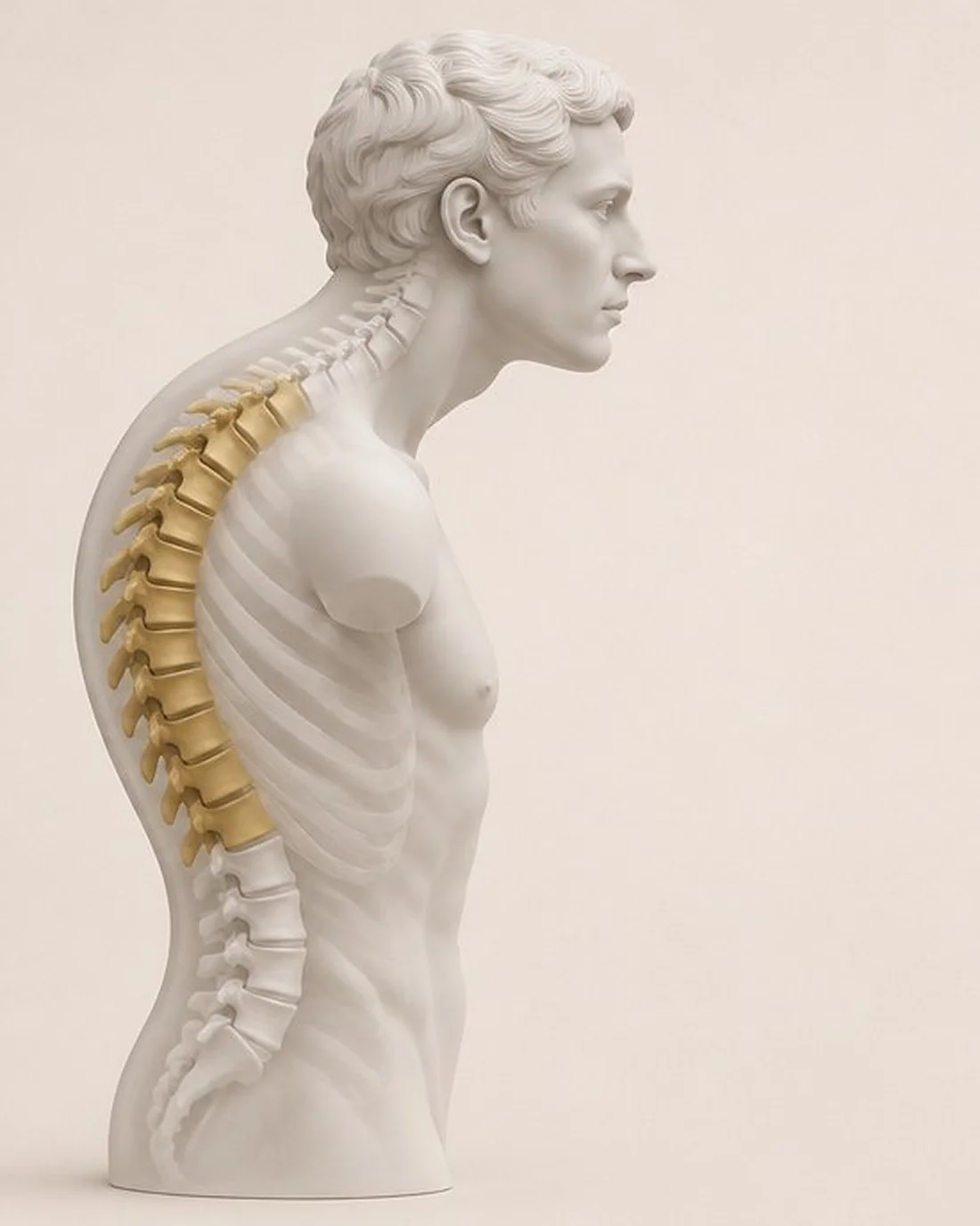
Rounded upper back, hard to stand up straight?
The thoracic spine has a natural backward curve, the kyphosis. When that curve increases, it is called thoracic hyperkyphosis. It is common in people who sit for work, in growing teenagers and with age, and it changes how the neck, shoulders and breathing work.
Last reviewed: November 2026 · Dr. Miguel Reis e Silva, Sports Medicine (OM 52856)
What is thoracic hyperkyphosis?
It is an increased curve of the upper and middle back. On X-ray, hyperkyphosis is usually defined as above about 40 to 45° (Cobb angle). There are two main forms:
Postural (flexible) hyperkyphosis: it corrects when the person straightens up or lies down. It is the most common and responds best to postural reeducation.
Structural (rigid) hyperkyphosis: with changes in vertebral shape, such as Scheuermann's disease in teenagers or osteoporotic vertebral fractures in older adults. It needs medical assessment.
Common signs
Pain or fatigue between the shoulder blades.
Head and shoulders drifting forward (forward head posture).
Difficulty raising the arms overhead.
Stiffness when rotating the trunk.
Why it happens
Prolonged sitting with little change of position during the day.
Weak back extensor muscles and a tight front chain (chest, upper abdominals).
Stiff thoracic spine in extension and rotation.
Rapid growth during adolescence.
Ageing and loss of bone and muscle mass.
Hyperkyphosis limits arm elevation and can contribute to shoulder and neck pain and, in older adults, to poorer balance. In lumbar hyperlordosis, the lower curve often compensates for the upper one.
How we measure it
We measure the curve without radiation, using biomechanical analysis:
Calibrated side-view photogrammetry, with markers on the spine, to estimate the thoracic curve.
Inclinometry of the thoracic spine, standing and in active extension, to separate what is flexible from what is rigid.
Thoracic mobility in extension and rotation, and overhead arm range.
Head and shoulder position (craniovertebral angle).
If the curve is rigid, marked or a vertebral change is suspected, we request an X-ray in a medical consultation. At reassessments we repeat the same measurements.
How we correct it
GPR sessions (global postural reeducation) — active postures that lengthen the front chain and work thoracic extension, with guided breathing.
Thoracic mobility — extension and rotation, with manual therapy when the spine is stiff.
Back extensor strength — progressive extension exercise is among the best-evidenced interventions to reduce the curve and improve function in hyperkyphosis.
Shoulder-blade and neck control — so the correction holds in daily life.
Clinical Pilates and strength training — to consolidate.
In teenagers with Scheuermann's disease and in vertebral fractures, the plan is decided with the doctor.
Postural reeducation at Myalgia
Hyperkyphosis is one of the four patterns we treat in our global postural reeducation (GPR / RPG) programme, with one-to-one 60-minute GPR sessions and doctors on site.
Myalgia Clinic Lisbon — Rua Adelaide Cabete 7A, Quinta da Luz, Carnide. See the clinic
Myalgia Clinic Almada — Rua Luís de Queiroz 5A, Almada town centre. See the clinic
Myalgia Center Miraflores — physiotherapy centre at Avenida das Túlipas 18A, Algés (Oeiras). See the centre
Other postural patterns
Frequently asked questions
Can hyperkyphosis be cured?
Postural, flexible hyperkyphosis improves a great deal with exercise and postural reeducation. In structural hyperkyphosis, the aim is to reduce pain, gain mobility and slow progression.
Which exercises help hyperkyphosis?
Progressive back extension, thoracic mobility and active lengthening of the front chain. They should be chosen after the assessment, because they depend on whether the curve is flexible or rigid.
Do I need an X-ray?
Not always. If the curve corrects when you straighten up and there are no warning signs, clinical assessment and biomechanical analysis are enough. We request an X-ray when the curve is rigid or marked.
Is hyperkyphosis in teenagers serious?
Most cases are postural and respond to exercise. A rigid or painful curve, especially during growth, should be assessed by a doctor to rule out Scheuermann's disease.
Will a brace fix hyperkyphosis?
Bracing has specific indications, mainly in teenagers with structural curves, decided by the doctor. For postural hyperkyphosis, the treatment is exercise.
How much does it cost?
Prices are on the booking page.