

Lumbar hyperlordosis: assessment and postural correction
We measure your lower-back curve, pelvic tilt and trunk control, and treat with global postural reeducation and targeted strength work.
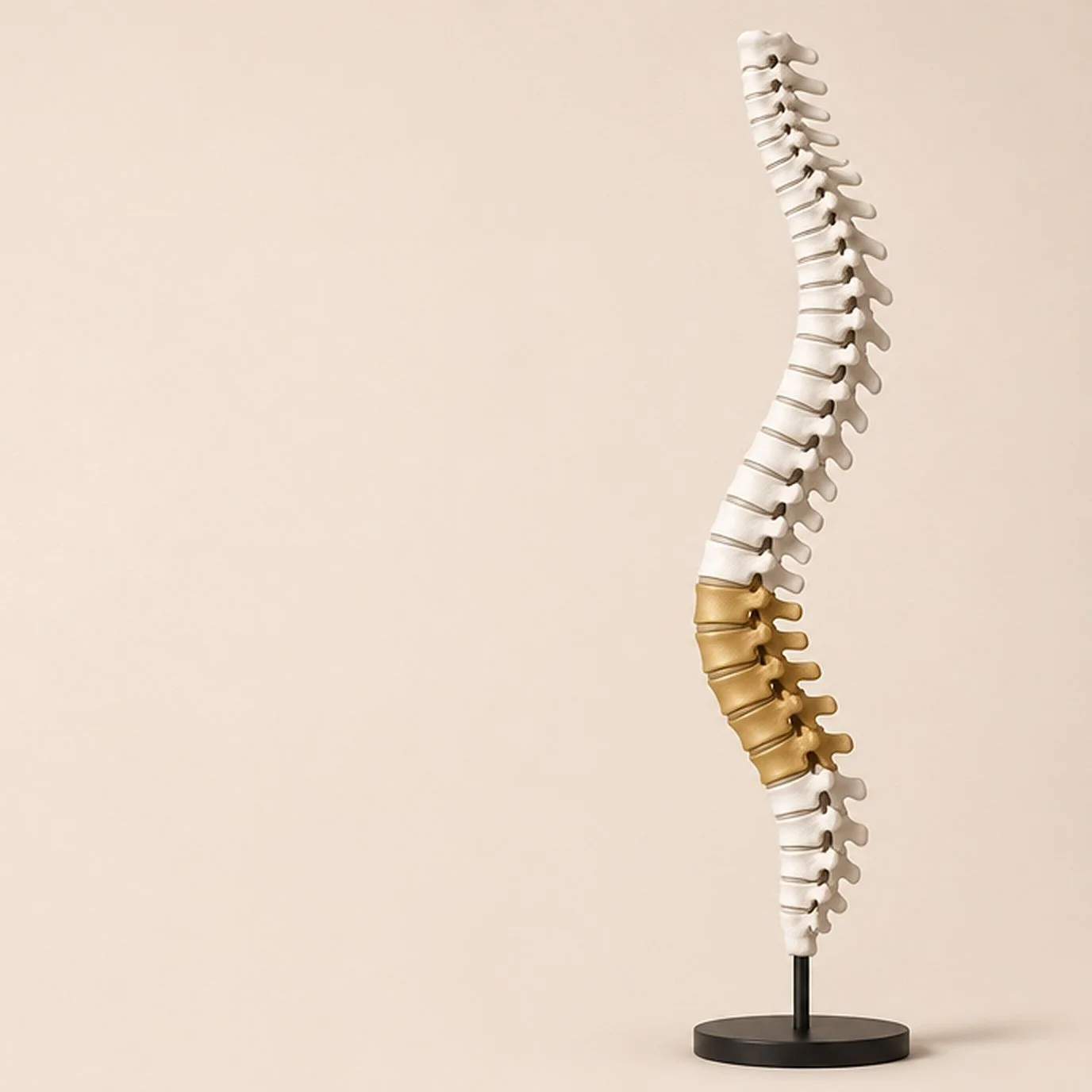
Low back pain when standing for long or when training?
The lumbar spine has a natural forward curve, the lordosis. When that curve increases, often with the pelvis tilted forward, it is called hyperlordosis. On its own it is not a disease, but it can concentrate load at the back of the spine and be linked to low back pain in certain activities.
Last reviewed: November 2026 · Dr. Miguel Reis e Silva, Sports Medicine (OM 52856)
What is lumbar hyperlordosis?
It is an increased curve of the lower back. It usually comes with anterior pelvic tilt: the pelvis tips forward, the abdomen pushes out and the buttocks become more prominent.
Common signs
Low back pain when standing for long, walking downhill or arching the back.
Low back pain during overhead exercises, squats or running.
A "stuck back" feeling on waking.
Difficulty controlling the pelvis when lifting the legs or holding a plank.
The curve above may compensate with thoracic hyperkyphosis.
Why it happens
Tight hip flexors, especially in people who sit all day.
Underactive glutes and deep abdominals, with poor lumbopelvic control.
Training compensations, such as arching the back to lift more weight overhead.
Pregnancy and changes in abdominal weight.
Individual anatomy of the pelvis and spine.
It is worth saying that the link between lumbar curve and pain is weak: many people have hyperlordosis and no pain. That is why we treat the person and the movement pattern, not just the angle. Read more about low back pain.
How we measure it
With biomechanical analysis, using calibrated photos and video:
Lumbar curve and pelvic tilt from the side, standing.
Lumbopelvic control — whether the lower back stays stable when the hips and arms move.
Hip flexor length (Thomas test) and hip mobility.
Strength and activation of the glutes and trunk muscles.
Squat and training movements on video, to see when and how much the spine arches.
We repeat the same measurements at each reassessment.
How we correct it
GPR sessions (global postural reeducation) — active postures that lengthen the hip flexors and the lower-back chain while activating the deep abdominals, with guided breathing.
Lumbopelvic dissociation — learning to move the hips without arching the spine.
Strength — glutes, deep abdominals and trunk muscles, with progressive load and transfer to daily and training movements.
Technique correction — in the squat, running and overhead work, with video biofeedback.
Clinical Pilates — to consolidate control.
If pain travels down the leg with tingling or weakness, the assessment starts with a medical consultation.
Postural reeducation at Myalgia
Hyperlordosis is one of the four patterns we treat in our global postural reeducation (GPR / RPG) programme, with one-to-one 60-minute GPR sessions and doctors on site.
Myalgia Clinic Lisbon — Rua Adelaide Cabete 7A, Quinta da Luz, Carnide. See the clinic
Myalgia Clinic Almada — Rua Luís de Queiroz 5A, Almada town centre. See the clinic
Myalgia Center Miraflores — physiotherapy centre at Avenida das Túlipas 18A, Algés (Oeiras). See the centre
Other postural patterns
Frequently asked questions
Can lumbar hyperlordosis be corrected?
The postural and movement pattern improves with postural reeducation and strength. What changes most is control of the pelvis and spine in everyday movements, which is what relates to pain.
Which exercises are good for hyperlordosis?
Active hip flexor lengthening, glute and deep abdominal strengthening and lumbopelvic dissociation exercises. The choice depends on the assessment.
Does hyperlordosis cause low back pain?
Not always. In some people and activities it can concentrate load on the joints at the back of the spine. We treat it when it relates to your pain or your training.
Can I keep training?
In most cases yes, with technique and load adjustments during the correction phase.
How much does it cost?
Prices are on the booking page.