
Platelet-rich plasma injections for musculoskeletal pain
Platelet-rich plasma injection is today one of the most promising approaches in the conservative treatment of musculoskeletal pain. For people living with persistent joint pain, recurring tendinopathy or cartilage wear, PRP is a minimally invasive alternative that uses the body's own biological resources to stimulate tissue repair.
Unlike conventional anti-inflammatories, which only ease symptoms temporarily, or surgery, which involves a long recovery, concentrated plasma treatment acts directly on the mechanisms of cell regeneration. It is a therapy with a growing body of scientific evidence that, in a specialist clinical setting, can make a real difference to a patient's quality of life.
In this article: what PRP is and how it is prepared, how it acts on injured tissue, which musculoskeletal conditions have the best-documented benefit, how long the effect lasts and what to expect from the clinical process at Clínica Myalgia.
What a plasma injection is and how it is prepared
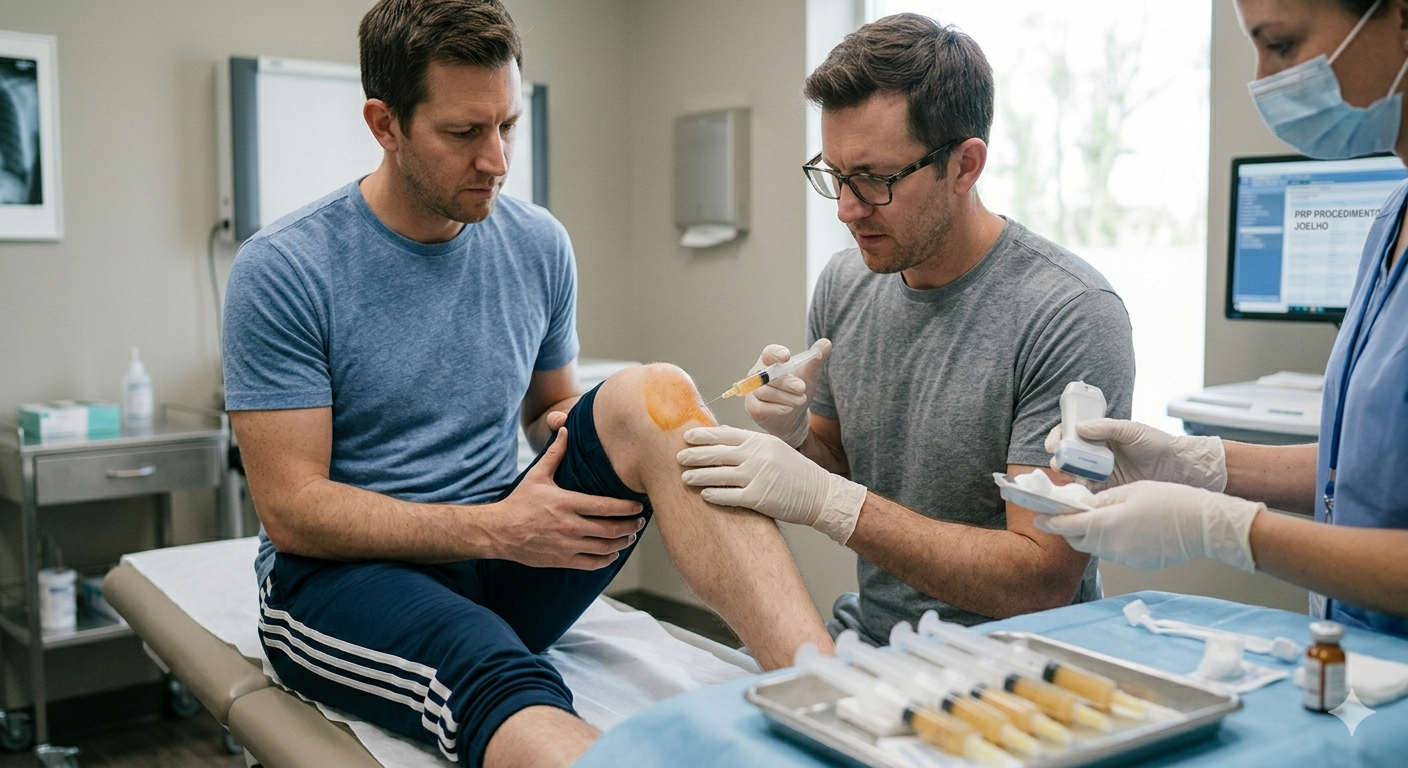
A platelet-rich plasma injection is a procedure in which a small amount of the patient's own blood is drawn, processed in a centrifuge to concentrate the platelets, and the concentrated solution is injected back into the injured area.
Platelets are specialised blood cells whose alpha granules hold a vast library of growth factors: PDGF, TGF-β, VEGF, IGF-1 and others. When activated at the injury site, they release these factors in a controlled way, triggering a cascade of tissue regeneration that includes:
Proliferation and migration of repair cells
Formation of new blood vessels (angiogenesis)
Synthesis of collagen and proteoglycans
Inhibition of catabolic cytokines such as IL-1 and TNF-alpha, which drive joint degradation
The result is an amplified biological response in an area that, for vascular or degenerative reasons, could no longer regenerate effectively on its own. The platelet concentration in the final preparation is generally three to five times higher than in circulating blood, which explains the therapeutic potency of the procedure.
Clinical note: the quality of PRP depends directly on the preparation protocol used. In a specialist setting, the process is tightly controlled to ensure the right concentration and no contamination.
What platelet-rich plasma is used for in musculoskeletal medicine
The available scientific evidence is strongest for a specific set of musculoskeletal conditions, and it is on that evidence that the clinical indication should be based.
The conditions with the strongest scientific support for PRP include:
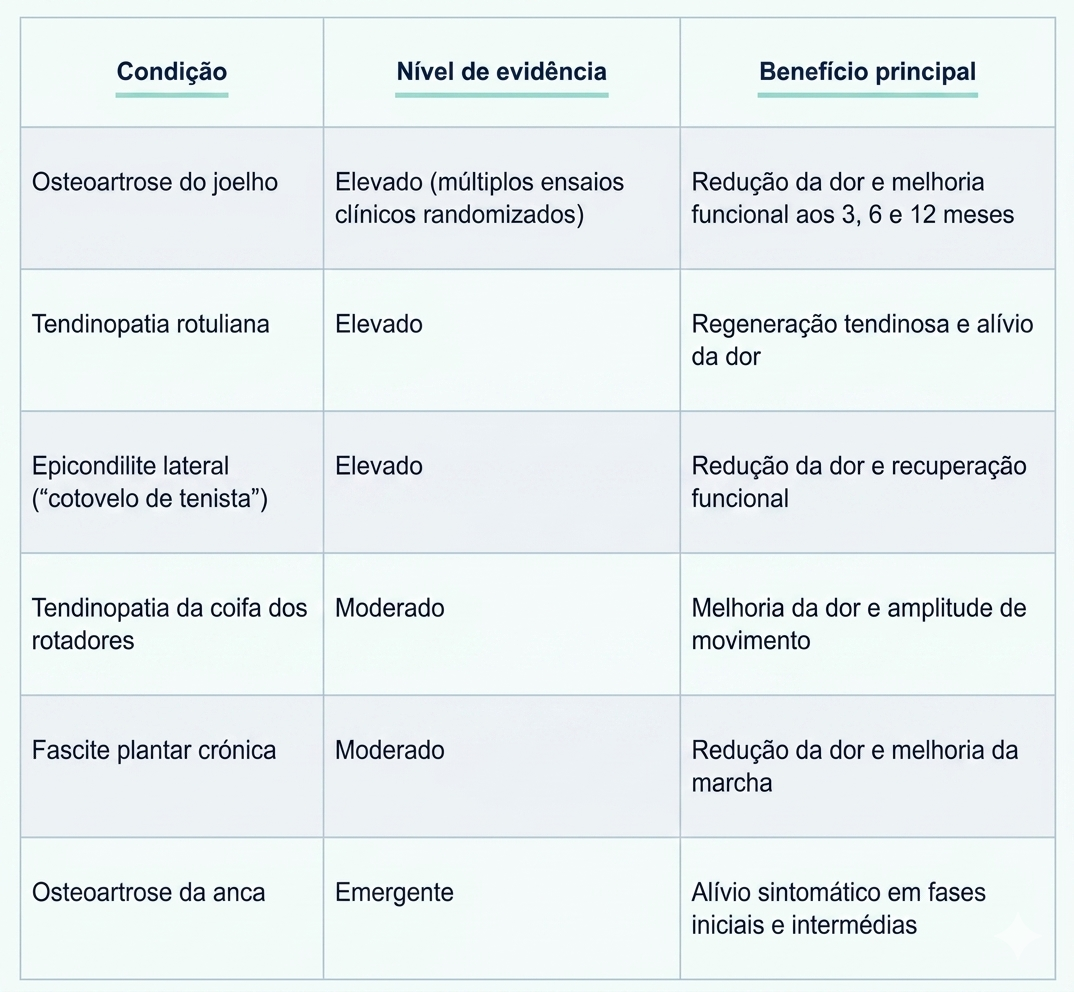
The evidence also makes clear that PRP is most effective in the early and intermediate stages of joint wear. In cases of advanced joint destruction, results are less predictable, and the indication should be weighed case by case in a specialist medical consultation.
PRP treatment: how the procedure works in clinical practice
PRP treatment is an outpatient procedure, meaning you arrive and leave the clinic the same day, with no hospital stay. The whole process, from blood draw to injection, typically takes 20 to 30 minutes.
From blood draw to injection: the steps of the procedure
The clinical protocol follows a well-defined sequence:
Venous blood draw — 15 to 50 ml of the patient's own blood is collected in specific tubes.
Centrifugation — the blood is spun in a centrifuge at a calibrated speed and time to separate the platelets from the plasma and red blood cells.
Obtaining the concentrate — a volume of PRP is obtained with a platelet concentration three to five times higher than circulating blood.
Image-guided injection — the PRP is injected into the target area, ideally under ultrasound guidance, to ensure precise placement.
Ultrasound guidance deserves particular emphasis. There is scientific evidence that up to half of injections performed using anatomical landmarks alone end up outside the target joint. Image guidance removes that margin of error and is a non-negotiable standard in high-quality musculoskeletal medicine.
Number of sessions and usual protocol
The number of injections varies with the condition and the patient's individual response. Most PRP protocols involve one to three sessions, two to four weeks apart.
After each session, some local discomfort is normal for the first 24 to 72 hours, reflecting the inflammatory response that precedes regeneration. Strenuous physical activity should be avoided during that time, but most patients return to their daily activities the same day.
Knee plasma injections: the best-evidenced use
Knee plasma injection is by far the most studied use of this therapy. Knee osteoarthritis affects a significant proportion of the adult population, and the search for alternatives that delay or avoid joint replacement surgery has driven a considerable amount of clinical research into PRP in this joint.
The available data are consistent: randomised controlled trials show significant reductions in pain and improvements in physical function at three, six and twelve months after treatment.
What sets PRP apart from other knee injections? The key difference is the mechanism of action. Corticosteroids act mainly as short-term anti-inflammatories and hyaluronic acid works mainly as a joint lubricant, whereas a knee plasma injection actively stimulates the processes that control tissue inflammation. It is not just about easing symptoms, but about creating the biological conditions for the joint to recover some of its function.
For people with knee pain linked to joint wear, this distinction is clinically relevant: PRP does not replace physiotherapy or other rehabilitation approaches, but it can be the complement that brings the patient to a level of comfort from which functional recovery work becomes possible.
How long PRP lasts and what influences the results
How long results last depends on the condition treated, the degree of degeneration, the number of sessions and each patient's individual characteristics.
Based on the available studies, results tend to follow this pattern:
First few weeks: there may be a temporary increase in pain, reflecting the initial inflammatory response. This is short-lived and part of the biological process.
1 to 3 months: the period when most patients start reporting a significant improvement in pain and mobility.
6 to 12 months: the period of greatest documented clinical benefit, with substantial reductions in pain and better function.
Up to 24 months: in mild to moderate osteoarthritis, some studies report results lasting two years, particularly after multiple injections.
What can work against the results:
Advanced joint destruction (grade IV osteoarthritis)
Active systemic disease that compromises platelet quality
Injection without ultrasound guidance, with a risk of missing the target area
No complementary rehabilitation after treatment
The clinical reality is that PRP is not a permanent solution for progressive degenerative conditions. It is a therapy that, when properly indicated and well performed, can provide significant windows of relief and substantially improve quality of life. In many patients, repeating the procedure after 12 to 18 months maintains the benefits.
Safety, contraindications and what makes a high-quality clinical setting
One of the most valued aspects of plasma injection is its safety profile. Because it uses autologous blood — the patient's own — the risk of allergic reaction or rejection is practically non-existent. There is no risk of transmitting infectious diseases through the procedure, and serious adverse effects are rare.
The most common side effects are local and short-lived: pain, swelling and redness at the injection site for the first 24 to 72 hours. Very occasionally, a more intense inflammatory reaction can occur, which usually settles without further treatment.
The main absolute contraindications include:
Active infection in the area to be treated
Uncontrolled thrombocytopenia or coagulopathy
Active cancer
Outside these situations, PRP is a safe option for the vast majority of adult patients with musculoskeletal conditions. Even so, the decision to go ahead should always follow a full clinical assessment, including imaging and a review of the medical history.
What makes a good clinical setting: PRP quality is not the same everywhere. How the concentrate is prepared, the centrifugation protocol, ultrasound guidance during injection and post-procedure follow-up all largely determine the results. In a specialist musculoskeletal setting such as Clínica Myalgia, all these factors are controlled and built into a personalised diagnostic and treatment approach.
For people with other musculoskeletal conditions that may benefit from injectable treatments, an initial assessment in a pain medicine consultation is the right starting point.
PRP as part of an integrated approach to musculoskeletal pain
Plasma injection is most effective as part of a broader treatment strategy, not on its own. The clinical evidence consistently points this way: PRP works best as a catalyst for a recovery process that includes physiotherapy, therapeutic exercise and, when needed, other complementary treatments.
In practice, this means that a patient who has a PRP injection and immediately returns to a sedentary life, or keeps the movement patterns that contributed to the original injury, tends to get poorer results than someone who complements treatment with a supervised rehabilitation programme.
Viscosupplementation with hyaluronic acid is another injectable treatment that can be combined with PRP in certain clinical contexts, particularly knee osteoarthritis with impaired joint lubrication. The choice of the most suitable combination always depends on the individual assessment.
In short: PRP is not a shortcut that lets you skip rehabilitation. It is a tool that, used well, creates the biological conditions for that work to produce better results, sooner.
Take the next step with a specialist assessment
If you're considering plasma injection as a treatment option, the first step is an assessment with a doctor specialising in musculoskeletal medicine. Only an accurate diagnosis, supported by up-to-date imaging, can determine whether PRP is the right approach for your specific condition and with which protocol.
At Clínica Myalgia, injectable treatments are performed under ultrasound guidance and built into a personalised treatment plan. Our team assesses every case on its own merits, without predefined protocols, because musculoskeletal pain is never the same in two patients.
Find out about our plans and clinical follow-up and discover how a structured approach can make a difference to your recovery.