
Exercise and GLP-1 agonists: lose weight without losing muscle
GLP-1 agonists — semaglutide and tirzepatide — have changed the treatment of obesity and type 2 diabetes. They lead to consistent weight loss and bring real health benefits. But part of the weight lost is not fat: it is muscle. And muscle that is lost and not regained has consequences.
At Clínica Myalgia we have created a supervised exercise programme, designed by Sports Medicine doctors and physiotherapists, for people on this treatment: to preserve and build strength and muscle mass while the weight comes down — and to keep the results afterwards.
I'd like to know more about the programme →
The benefits of GLP-1 treatment
GLP-1 agonists act on appetite and satiety and reduce calorie intake. Clinical trials show average weight loss of around 15% with semaglutide and over 20% with tirzepatide after about a year and a half — results that, until recently, only bariatric surgery could achieve.
Beyond weight, the benefits are broad and well documented: better control of blood glucose and HbA1c; lower blood pressure and triglycerides; fewer major cardiovascular events in people with established cardiovascular disease; improvement in sleep apnoea and fatty liver; and less pain and better function in knee osteoarthritis, largely thanks to reduced joint load.
It is therefore a treatment that makes sense for many people — when prescribed and monitored by their own doctor. What follows is not an argument against the treatment. It is an argument for doing it well.
The less-discussed side: loss of muscle mass
When the body loses weight quickly, with little protein intake and little mechanical stimulus, it doesn't lose only fat. In studies measuring body composition (DXA), a significant part of the weight lost with GLP-1 agonists — in some trials between a quarter and about 40% — is lean mass, which includes skeletal muscle.
Losing some lean tissue is normal with any weight loss. The problem arises when that loss is large, rapid and not compensated: that is when we talk about sarcopenia — the loss of muscle mass, strength and function. In a person aged 55 or 65, who is already naturally losing muscle mass every year, the treatment can speed up in months a process that would otherwise take a decade.
There are three reasons why this often happens during treatment:
- Less appetite almost always means less protein — and muscle needs it to be maintained.
- Rapid weight loss puts the body into a marked negative energy balance, in which muscle is also used as a source of energy.
- Without strength training, there is no signal telling the body to keep its muscle.
The consequences of sarcopenia
Muscle isn't just for lifting weights. It is the body's largest metabolic organ and what keeps us independent as we age. Losing it has real consequences:
- Slower metabolism and rebound weight gain. Less muscle means fewer calories burned at rest. When treatment ends or the dose is reduced, weight tends to come back — mostly as fat, leaving the person with a worse body composition than at the start.
- Poorer insulin sensitivity. Muscle is the main destination for glucose after meals. Losing it works against one of the goals of the treatment.
- Weakness, fatigue and reduced function. Difficulty climbing stairs, getting up from a chair or carrying bags; lower tolerance for everyday exertion.
- More pain and more injuries. Less strength in the muscles that stabilise the knee, hip and spine means more load on joints and tendons — one of the most common causes of pain we see in clinic.
- Loss of bone mass. Rapid weight loss and less muscle pull on bone increase the risk of osteopenia and, over time, fractures.
- Falls and frailty in older people, and a worse starting point if illness or surgery comes along.
What the evidence recommends
International recommendations for managing obesity with medication are consistent: treatment should be accompanied by structured strength training, at least twice a week, and by adequate protein intake (around 1.2 to 1.6 g per kg of body weight per day, adjusted case by case). Studies that combined exercise with drug treatment show better preservation of lean mass, better function and — above all — better weight maintenance after stopping the medication.
Strength training is the most effective stimulus for getting the body to maintain and build muscle while it loses fat. It isn't optional. It is part of the treatment.
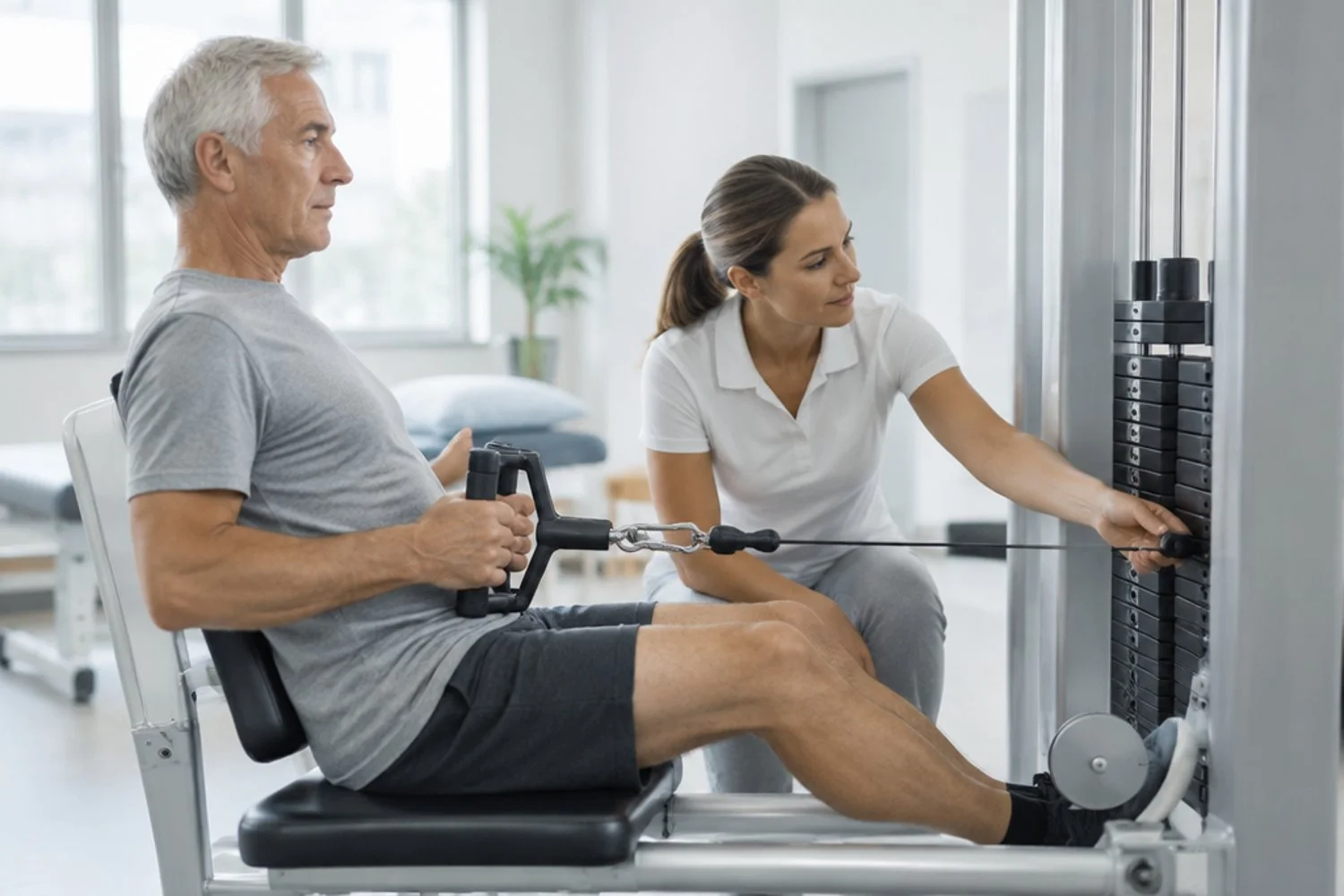
Myalgia Supervised Exercise Programme
A clinical programme for people who are on — or about to start — treatment with GLP-1 agonists, working alongside their prescribing doctor.
1. An individual plan
A progressive strength training programme designed for you — loads, exercises and volume adapted to your fitness, your joints and the stage of treatment you are at. We include protein-focused nutritional guidance, coordinated with a nutritionist when indicated.
2. Supervised training
One-to-one strength training sessions, always supervised by a physiotherapist, twice a week, at our premises in Lisbon, Almada or Miraflores. Correct technique, safe progression and real-time adjustment — especially in the weeks when the dose is increased and energy and appetite drop.
3. Continuity and independence
Throughout the programme you receive constant feedback from your physiotherapist on your progress and, if needed, clinical support from our doctors. The ultimate goal is independence: leaving the programme with the habit and the ability to keep training — and keeping the results after treatment.
Who it's for
- People being treated with semaglutide or tirzepatide, or about to start
- Anyone who has already lost weight and feels weak, tired or less toned
- People over 50, for whom sarcopenia is an added concern
- Anyone with joint pain (knee, hip, back) who needs to train safely
- Anyone who has never done strength training and doesn't know where to start
Why Myalgia?
Sports Medicine, Physical and Rehabilitation Medicine and Orthopaedic doctors and physiotherapists working under one roof, with a movement analysis lab and the methodology of elite sports medicine at everyone's service — from people who have never trained to those who train a lot. If pain or an injury is stopping you from training, we treat the cause and build your recovery into the programme.
Frequently asked questions
Can I exercise during treatment with semaglutide or tirzepatide? Yes — and you should. Strength training is the main way to prevent loss of muscle mass during treatment. The programme is adapted to your condition and to any side effects you may feel (nausea, fatigue), especially in the first weeks and when the dose is increased.
What kind of exercise prevents sarcopenia? Progressive strength (resistance) training is the most effective — 2 to 3 sessions a week, with loads that challenge the muscle. Walking or running are good for cardiovascular health but, on their own, do not preserve muscle mass.
Isn't increasing protein enough? Protein is essential, but without a mechanical stimulus the body has no reason to keep its muscle. Protein and strength training work together.
Do I need a referral from my doctor? It isn't required, but we work alongside the doctor who prescribes your treatment. Myalgia does not prescribe or manage GLP-1 agonist medication.
I have knee, hip or back pain. Can I take part? Yes. The programme is built around your pain or limitation. When needed, we include physiotherapy or a medical consultation under the same roof.
Where does the programme take place? At Clínica Myalgia Lisboa (Carnide), Clínica Myalgia Almada and Myalgia Center Miraflores (Algés).
This page is for information only and does not replace advice from your doctor.